
In the realm of undergraduate physics, few problems are as iconic or as pedagogically significant as the classic circuit analysis involving an ideal battery and a time-varying magnetic field. Whether you have encountered this as “Figure (a) shows a circuit consisting of an ideal battery” on Chegg, Numerade, or within your university textbook, understanding the underlying principles of Faraday’s Law is essential for mastering electromagnetism in 2026.
This article serves as a comprehensive guide to deconstructing these complex physics problems. We will explore how magnetic flux, induced electromotive force (emf), and circuit resistance interact to create a dynamic electrical system. By the end of this deep dive, you will have the tools to solve similar problems with confidence.
Understanding the Fundamentals of the Circuit
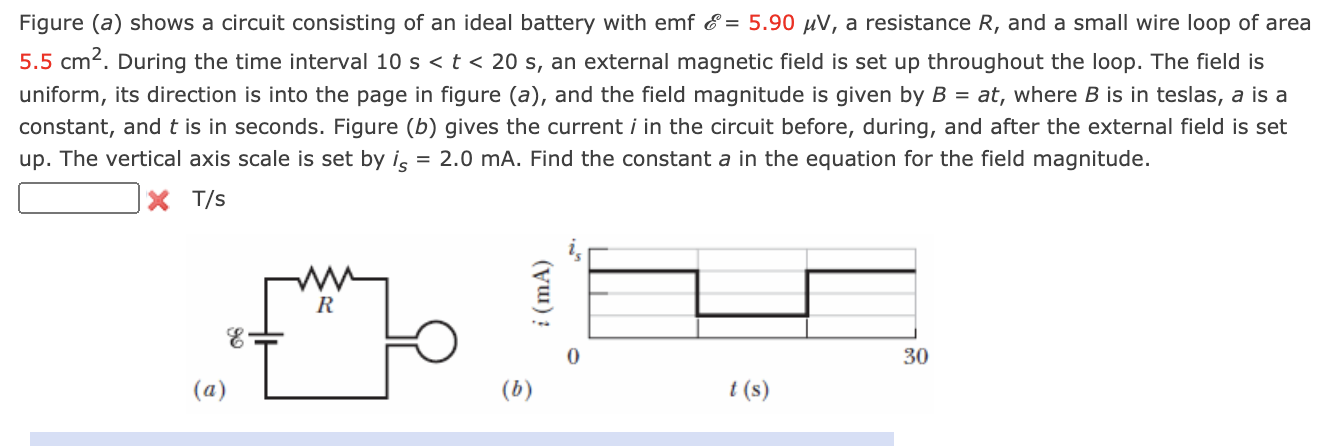
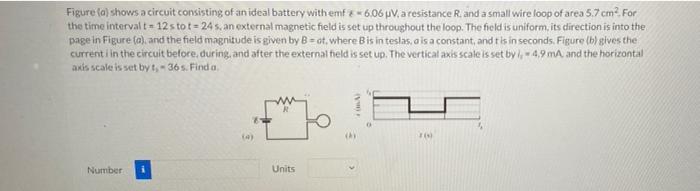
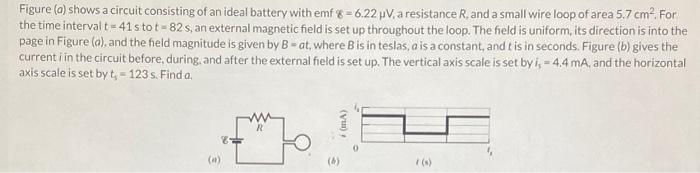
At the heart of these problems lies a circuit containing an ideal battery with a specified electromotive force (emf), typically denoted in microvolts (μV) or volts (V), a resistor (R), and a wire loop with a defined surface area. The core challenge in these problems is not just the battery itself, but the introduction of an external magnetic field that changes over time.
The Role of Faraday’s Law
Faraday’s Law of Induction states that the magnitude of the induced emf in a circuit is directly proportional to the rate of change of the magnetic flux through the loop. Mathematically, this is expressed as:
ε = -dΦB / dt
When the magnetic field (B) varies as a function of time, such as in the expression B = at (where a is a constant), the magnetic flux (ΦB = B × A) also changes. This change creates an induced current that either opposes or assists the current provided by the battery, depending on Lenz’s Law.
Step-by-Step Breakdown of the Problem
To solve the “Figure (a)” circuit problem, students must follow a systematic approach. Most iterations of this problem, seen across platforms like Chegg and Filo, require you to calculate the net current at specific time intervals.
1. Identify the Constants
First, extract the given variables from the prompt. Are you dealing with a battery emf of 6.31 μV? What is the area of the loop (e.g., 8.1 cm²)? What is the range of the time interval (e.g., 19s to 38s)? Converting all units to SI units (meters, seconds, teslas) is the most common pitfall for students.
2. Formulate the Magnetic Flux Equation
The magnetic flux is the product of the magnetic field magnitude and the cross-sectional area of the loop. If the field is uniform and perpendicular to the loop, the formula simplifies to:
ΦB = (at) × A
3. Calculate the Induced EMF
Once you have the flux equation, take the derivative with respect to time to find the induced emf. Since the derivative of at with respect to t is simply a, the induced emf becomes:
ε_induced = -a × A
Why External Magnetic Fields Matter
In modern electrical engineering, understanding how external magnetic fields interact with stationary circuits is vital. In 2026, as we advance in wireless power transfer and inductive charging technologies, the principles illustrated in these “Figure (a)” problems are no longer just theoretical exercises—they are the foundation of how we charge our mobile devices and electric vehicles.
Lenz’s Law and Directionality
One of the most engaging aspects of this problem is determining the direction of the current. Lenz’s Law dictates that the induced current will create its own magnetic field to oppose the change in the external magnetic field. If the field is increasing into the page, the circuit will induce a current that attempts to create a field pointing out of the page.
Analyzing the Time Interval
The specific time interval (e.g., 10s to 20s) is crucial. In many versions of this problem, the field is zero outside of this window. This means the induced emf only exists during that specific duration, causing a sudden jump or “spike” in the total circuit current. Calculating this jump is often the final step in the problem.
Common Pitfalls and How to Avoid Them
Even advanced physics students often trip over simple arithmetic or conceptual misunderstandings. Here is how to keep your work clean:
Unit Mismatch: Always ensure your area is in square meters (m²), not square centimeters (cm²). A common error is forgetting to multiply the cm² value by 10⁻⁴.
Sign Convention: Remember that the negative sign in Faraday’s Law represents the opposition to the change. When calculating the magnitude of the current, use absolute values unless the direction is specifically requested.
Constant ‘a’: In the equation B = at, ensure you solve for the constant a* using the boundary conditions provided in the problem statement.
Real-World Applications of Circuit Induction
While the “ideal battery and loop” circuit might seem like a textbook abstraction, it mirrors real-world electromagnetic phenomena.
Inductive Sensors
Proximity sensors used in manufacturing lines rely on these exact principles. When a metallic object enters the magnetic field of a sensor loop, it changes the flux, inducing a current that the system detects to confirm the object’s presence.
Electromagnetic Compatibility (EMC)
Engineers must design circuits that are resistant to external magnetic interference. By studying how a loop circuit reacts to a changing field, we learn how to shield sensitive electronics from “noise” or induced currents that could lead to signal degradation or hardware failure.
Conclusion: The Path to Academic Success
Solving “Figure (a)” circuit problems requires a blend of mathematical rigor and conceptual understanding. By breaking the problem down into the battery component and the induced component, you can effectively model any circuit subjected to a time-varying magnetic field.
As we look toward 2026 and beyond, the ability to analyze these interactions remains a critical skill for students in physics and engineering. Whether you are using resources like Chegg, Numerade, or simply your lecture notes, remember that the goal is to understand the physics, not just to find the final numerical answer. Keep practicing your derivatives, stay consistent with your SI units, and you will find that even the most complex electromagnetic circuits become intuitive.